seats TESLA MODEL S 2017 (UK) User Guide
[x] Cancel search | Manufacturer: TESLA, Model Year: 2017, Model line: MODEL S, Model: TESLA MODEL S 2017Pages: 186, PDF Size: 4.67 MB
Page 29 of 186
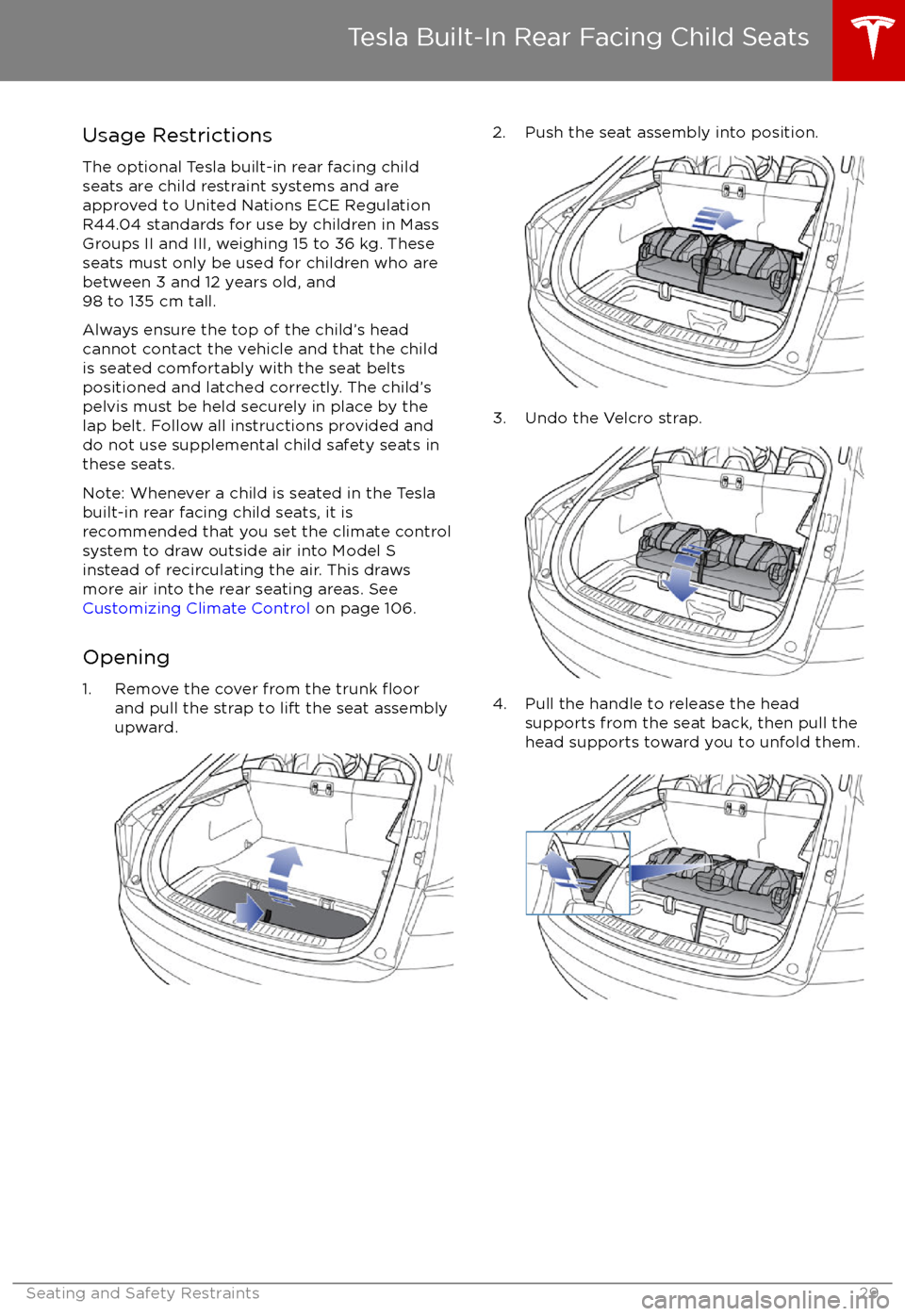
Usage RestrictionsThe optional Tesla built-in rear facing childseats are child restraint systems and are
approved to United Nations ECE Regulation
R44.04 standards for use by children in Mass
Groups II and III, weighing 15 to 36 kg. These
seats must only be used for children who are
between 3 and 12 years old, and
98 to 135 cm tall.
Always ensure the top of the child
Page 30 of 186
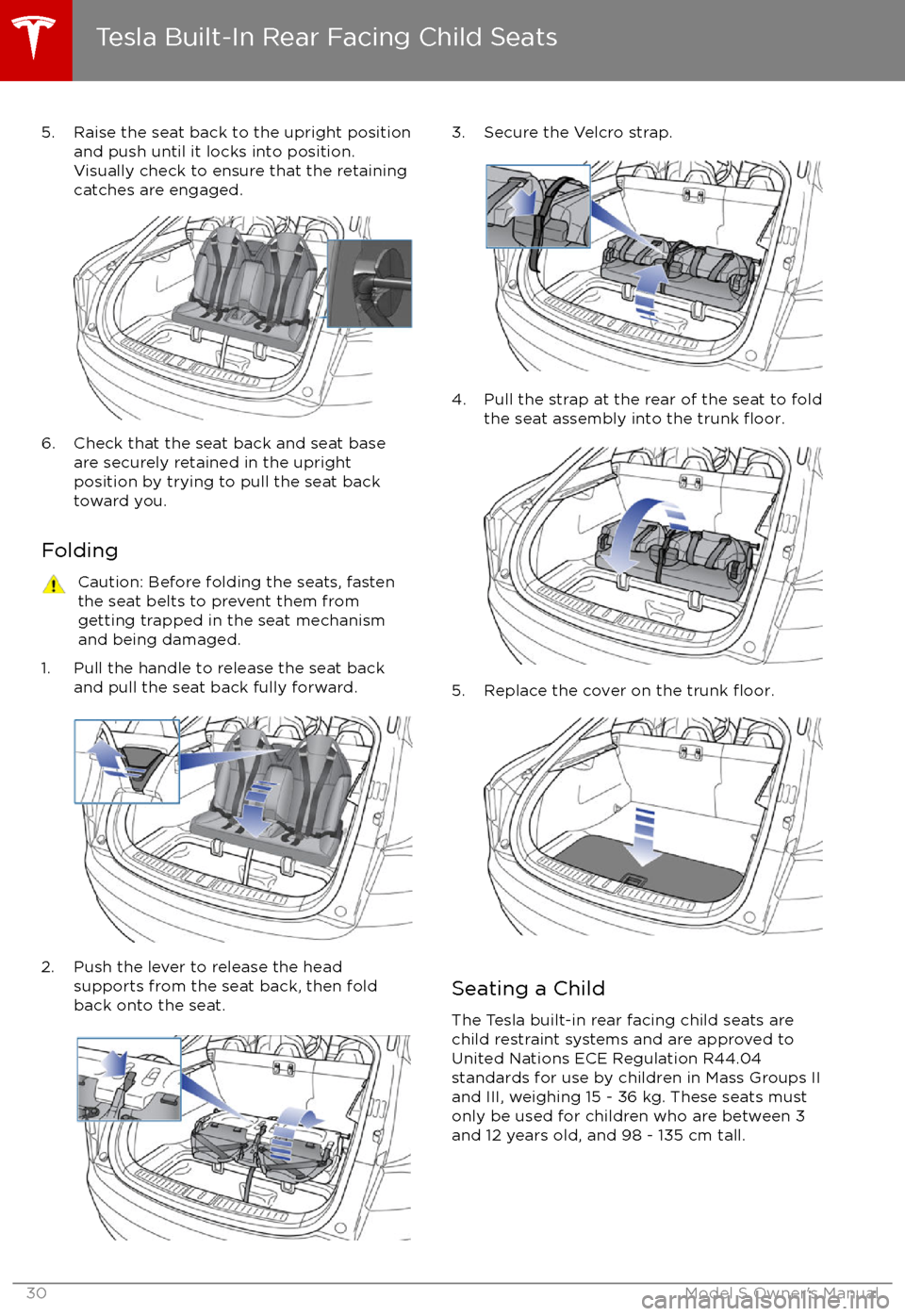
5. Raise the seat back to the upright positionand push until it locks into position.Visually check to ensure that the retaining
catches are engaged.
6. Check that the seat back and seat base are securely retained in the upright
position by trying to pull the seat back
toward you.
Folding
Caution: Before folding the seats, fasten
the seat belts to prevent them from
getting trapped in the seat mechanism
and being damaged.
1. Pull the handle to release the seat back and pull the seat back fully forward.
2. Push the lever to release the head
supports from the seat back, then fold
back onto the seat.
3. Secure the Velcro strap.
4. Pull the strap at the rear of the seat to fold the seat assembly into the trunk floor.
5. Replace the cover on the trunk floor.
Seating a Child
The Tesla built-in rear facing child seats are
child restraint systems and are approved to
United Nations ECE Regulation R44.04
standards for use by children in Mass Groups II
and III, weighing 15 - 36 kg. These seats must
only be used for children who are between 3
and 12 years old, and 98 - 135 cm tall.
Tesla Built-In Rear Facing Child Seats
30Model S Owner
Page 32 of 186
Warnings - Tesla Child SeatsWarning: The Tesla built-in rear facing
seats are child restraint systems and are
approved to United Nations ECE
Regulation R44.04 standards for use by
children in Mass Groups II and III,
weighing 15 to 36 kg. These seats must
only be used for children who are
between 3 and 12 years old, and
98 to 135 cm tall, provided the top of the
child
Page 35 of 186

Disabling the Passenger Front
Airbags
When a child is seated in the front passenger
seat (even when the child is seated in a child safety seat or booster seat), you must disable
the passenger front airbags to prevent them
from injuring the child if a collision occurs.
Note: Rear seats are the preferred location for
seating children in child safety seats.
To turn
off the front and side airbags on the
passenger side of the vehicle, touch Controls
> Settings > Safety & Security > Passenger
Front Airbag .
The OFF status of the front passenger airbag
displays in the upper right corner of the
touchscreen. (When the airbag is ON, no status is displayed on the touchscreen.)
If the airbag is on, even if you have turned itoff (or vice versa), contact Tesla immediately.
Note: Model S has a capacitive touchscreen and may not respond to your touch if you are
wearing standard gloves. If the touchscreen is
not responding, remove gloves or wear gloves
with conductive
fingertips for use with
capacitive touchscreens.
Warning: Never seat a child in a child
safety seat or a booster seat on the front
passenger seat when the airbag is
activated. Doing so can cause serious injury or death.Warning: If the passenger airbag control
does not appear to be functioning, do not
seat a passenger in the front seat.
Contact Tesla immediately to have the
vehicle inspected and if necessary,
repaired.Warning: Do not use seat covers on
Model S. Doing so could restrict
deployment of the side air bags if an
accident occurs.
Inflation Effects
When airbags inflate, a fine powder is
released. This powder can irritate the skin and
should be thoroughly
flushed from the eyes
and from any cuts or abrasions.
After
inflation, the airbags deflate to provide a
gradual cushioning effect for the occupants
and to ensure the driver
Page 53 of 186

5. If Model S is equipped with a coil suspension system, you can adjust the angle of theheadlights to accommodate the load you are carrying. You may need to lower the angle of theheadlights to avoid blinding oncoming drivers in situations when you are carrying a
significantamount of weight in the rear trunk. After touching LEVEL, drag the slider to the desiredposition:
0Headlights are not lowered. No change is needed when all front and rear seats are
occupied and only the front trunk is laden.1Headlights are lowered one level. Suitable when the front and rear seats are occupied and the rear trunk is laden.2Headlights are lowered two levels. Suitable when carrying heavy loads.
Note: Headlight adjustments are not available if Model S is equipped with Smart Air
Suspension because Model S levels automatically.
6. Exterior lights (headlights, tail lights, side marker lights, parking lights, and license plate lights) are set to AUTO each time you start Model S.
AUTOExterior lights automatically turn on when driving in low lighting
conditions. If you change to a different setting, lights always revert to this
AUTO setting on your next drive.
Touch one of these options to temporarily change the exterior light setting:
OFFExterior lights turn off until you manually turn them back on or until the
next time you drive Model S. If daytime running lights are required in your
region, the exterior lights used for this purpose do not turn
off.Only the side marker lights, parking lights, tail lights and license plate
lights turn on.Exterior lights turn on.
Note: Model S has a series of lights along the lower rim of the headlights, also referred to as
"signature" lights. These lights automatically turn on whenever Model S is powered on and a driving gear is engaged.
Warning: Always ensure that your headlamps are switched to AUTO or ON, as
appropriate, during all low visibility conditions. Failure to do so may result in a collision.
Lights
Driving53
Page 105 of 186
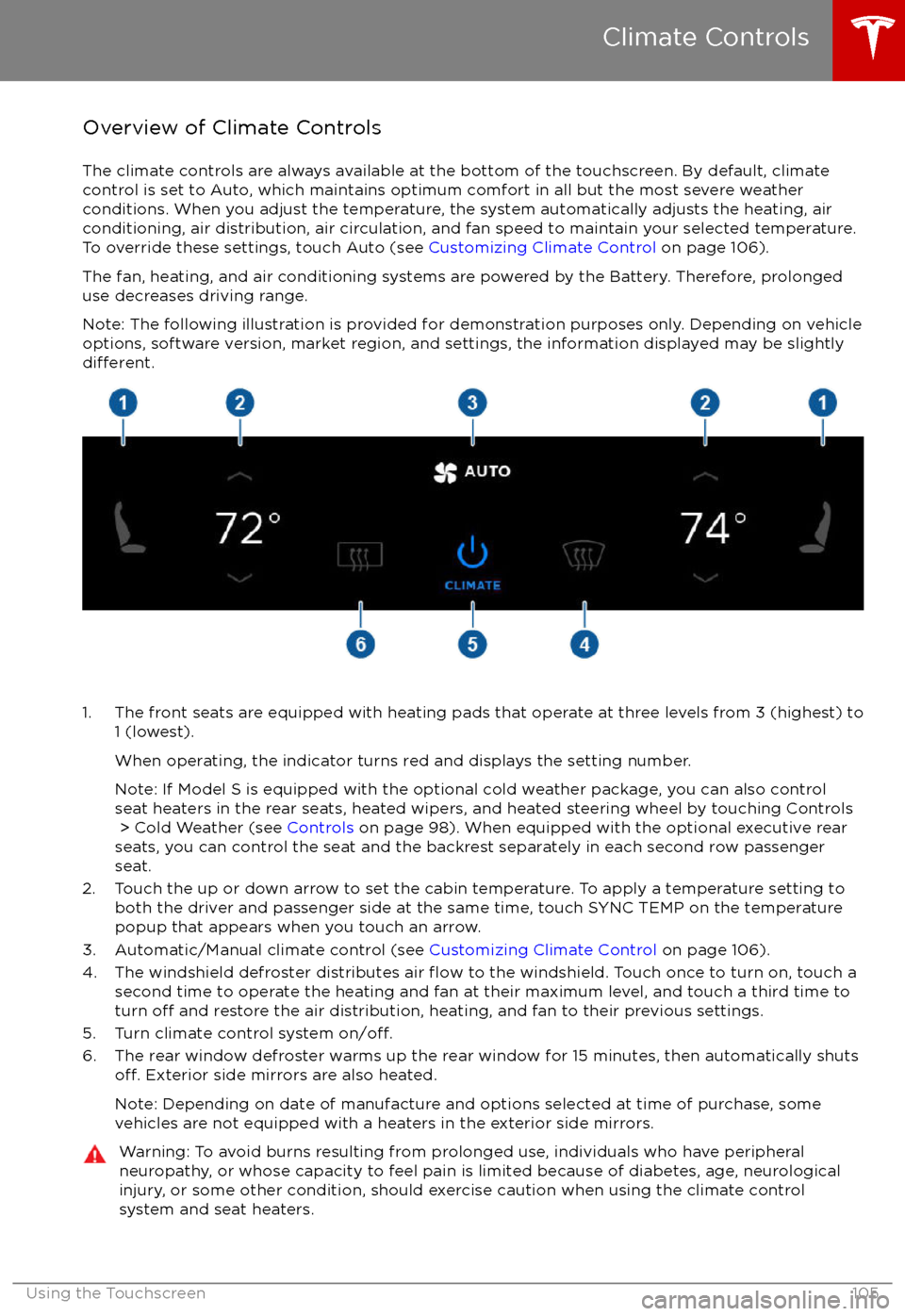
Overview of Climate Controls
The climate controls are always available at the bottom of the touchscreen. By default, climate control is set to Auto, which maintains optimum comfort in all but the most severe weather conditions. When you adjust the temperature, the system automatically adjusts the heating, air
conditioning, air distribution, air circulation, and fan speed to maintain your selected temperature. To override these settings, touch Auto (see Customizing Climate Control on page 106).
The fan, heating, and air conditioning systems are powered by the Battery. Therefore, prolonged
use decreases driving range.
Note: The following illustration is provided for demonstration purposes only. Depending on vehicle
options, software version, market region, and settings, the information displayed may be slightly
different.
1. The front seats are equipped with heating pads that operate at three levels from 3 (highest) to
1 (lowest).
When operating, the indicator turns red and displays the setting number.
Note: If Model S is equipped with the optional cold weather package, you can also control seat heaters in the rear seats, heated wipers, and heated steering wheel by touching Controls > Cold Weather (see Controls on page 98). When equipped with the optional executive rear
seats, you can control the seat and the backrest separately in each second row passenger
seat.
2. Touch the up or down arrow to set the cabin temperature. To apply a temperature setting to both the driver and passenger side at the same time, touch SYNC TEMP on the temperaturepopup that appears when you touch an arrow.
3. Automatic/Manual climate control (see Customizing Climate Control on page 106).
4. The windshield defroster distributes air
flow to the windshield. Touch once to turn on, touch a
second time to operate the heating and fan at their maximum level, and touch a third time to
turn
off and restore the air distribution, heating, and fan to their previous settings.
5. Turn climate control system on/off.6. The rear window defroster warms up the rear window for 15 minutes, then automatically shutsoff. Exterior side mirrors are also heated.
Note: Depending on date of manufacture and options selected at time of purchase, some vehicles are not equipped with a heaters in the exterior side mirrors.
Warning: To avoid burns resulting from prolonged use, individuals who have peripheral neuropathy, or whose capacity to feel pain is limited because of diabetes, age, neurologicalinjury, or some other condition, should exercise caution when using the climate control
system and seat heaters.
Climate Controls
Using the Touchscreen105
Page 107 of 186
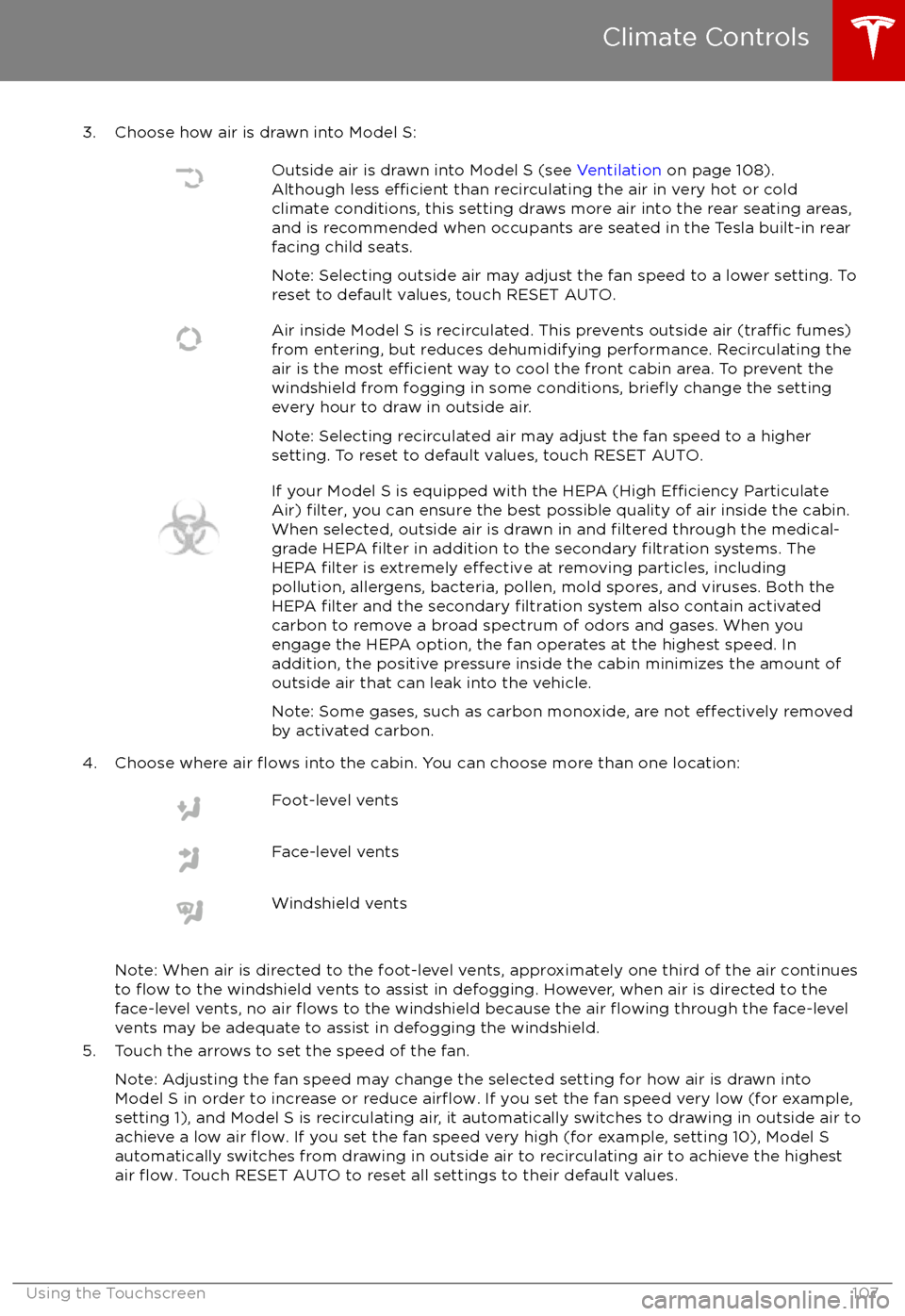
3. Choose how air is drawn into Model S:Outside air is drawn into Model S (see Ventilation on page 108).
Although less efficient than recirculating the air in very hot or cold
climate conditions, this setting draws more air into the rear seating areas,
and is recommended when occupants are seated in the Tesla built-in rear facing child seats.
Note: Selecting outside air may adjust the fan speed to a lower setting. To
reset to default values, touch RESET AUTO.Air inside Model S is recirculated. This prevents outside air (traffic fumes)
from entering, but reduces dehumidifying performance. Recirculating the
air is the most
efficient way to cool the front cabin area. To prevent the
windshield from fogging in some conditions, briefly change the setting
every hour to draw in outside air.
Note: Selecting recirculated air may adjust the fan speed to a higher
setting. To reset to default values, touch RESET AUTO.
If your Model S is equipped with the HEPA (High Efficiency Particulate
Air) filter, you can ensure the best possible quality of air inside the cabin.
When selected, outside air is drawn in and filtered through the medical-
grade HEPA filter in addition to the secondary filtration systems. The
HEPA filter is extremely effective at removing particles, including
pollution, allergens, bacteria, pollen, mold spores, and viruses. Both the
HEPA
filter and the secondary filtration system also contain activated
carbon to remove a broad spectrum of odors and gases. When you
engage the HEPA option, the fan operates at the highest speed. In
addition, the positive pressure inside the cabin minimizes the amount of
outside air that can leak into the vehicle.
Note: Some gases, such as carbon monoxide, are not
effectively removed
by activated carbon.
4. Choose where air flows into the cabin. You can choose more than one location:
Foot-level ventsFace-level ventsWindshield vents
Note: When air is directed to the foot-level vents, approximately one third of the air continues
to flow to the windshield vents to assist in defogging. However, when air is directed to the
face-level vents, no air flows to the windshield because the air flowing through the face-level
vents may be adequate to assist in defogging the windshield.
5. Touch the arrows to set the speed of the fan.
Note: Adjusting the fan speed may change the selected setting for how air is drawn intoModel S in order to increase or reduce
airflow. If you set the fan speed very low (for example,
setting 1), and Model S is recirculating air, it automatically switches to drawing in outside air to
achieve a low air
flow. If you set the fan speed very high (for example, setting 10), Model S
automatically switches from drawing in outside air to recirculating air to achieve the highest
air
flow. Touch RESET AUTO to reset all settings to their default values.
Climate Controls
Using the Touchscreen107
Page 150 of 186

Cleaning the Interior
Frequently inspect and clean the interior to maintain its appearance and to prevent
premature wear. If possible, immediately wipe up spills and remove marks. For general
cleaning, wipe interior surfaces using a soft
cloth (such as micro
fiber) dampened with a
mixture of warm water and mild non-
detergent cleaner (test all cleaners on a
concealed area before use). To avoid streaks,
dry immediately with a soft lint-free cloth.
Interior Glass
Do not scrape, or use any abrasive cleaning
fluid on glass or mirrored surfaces. This can
damage the reflective surface of the mirror
and the heating elements in the rear window.
Airbags
Do not allow any substance to enter an airbag
cover. This could
affect correct operation.
Dashboard and Plastic Surfaces
Do not polish the upper surfaces of the
dashboard. Polished surfaces are
reflectiveand could interfere with your driving view.
Leather Seats
Leather is prone to dye-transfer which can
cause discoloration, particularly on light colored leather. White and tan leather iscoated with an anti-soiling treatment. Wipespills as soon as possible using a soft cloth
moistened with warm water and non-
detergent soap. Wipe gently in a circular
motion. Then wipe dry using a soft, lint-free
cloth. Using detergents or commercially
available leather cleaners and conditioners is
not recommended because they can discolor or dry out the leather.
Polyurethane Seats
Wipe spills as soon as possible using a soft
cloth moistened with warm water and non-
detergent soap. Wipe gently in a circular
motion. After cleaning, allow the seats to air
dry.
Cloth Seats
Wipe spills as soon as possible using a soft
cloth moistened with warm water and non-
detergent soap. Wipe gently in a circular
motion. Then wipe dry using a soft, lint-free
cloth. Vacuum the seats as needed to remove
any loose dirt.
Carpets
Avoid over-wetting carpets. For heavily soiled
areas, use a diluted upholstery cleaner.
Seat Belts
Extend the belts to wipe. Do not use any type
of detergent or chemical cleaning agent.
Allow the belts to dry naturally while
extended, preferably away from direct
sunlight.
Tesla Built-In Rear Facing Child Seats
Vacuum the seats to remove any loose dirt. Wipe the seats with a soft cloth dampened
with warm water. You can also use an upholstery cleaner designed for automotive
use. Extend the belts to wipe. Allow the belts
to dry naturally, preferably away from direct
sunlight.
Touchscreen and Instrument Panel
Clean the touchscreen and instrument panel
using a soft lint-free cloth
specificallydesigned to clean monitors and displays. Do not use cleaners (such as a glass cleaner) and
do not use a wet wipe or a dry statically- charged cloth (such as a recently washed
microfiber). To wipe the touchscreen without
activating buttons and changing settings, you
can enable clean mode. Touch Controls > Displays > Clean Mode . The display darkens
to make it easy to see dust and smudges.
Chrome and Metal Surfaces
Polish, abrasive cleaners or hard cloths can
damage the
finish on chrome and metal
surfaces.
Cautions for Interior Cleaning
Caution: Using solvents (including alcohol), bleach, citrus, naphtha, orsilicone-based products or additives on
interior components can cause damage.Caution: Statically-charged materials can
cause damage to the touchscreen or
instrument panel.Warning: If you notice any damage on an
airbag or seat belt, contact Tesla
immediately.Warning: Do not allow any water,
cleaners, or fabric to enter a seat belt
mechanism.Warning: Exposure to chemical cleaners
can be hazardous and can irritate eyes
Cleaning
150Model S Owner
Page 163 of 186

Cargo VolumeTotal cargo volume (rear seats not
folded)28.4 cu ft804.2 LRear cargo volume26.3 cu ft744.7 LRear cargo volume (with seats
folded down)58.1 cu ft1645.2 LFront cargo volume2.1 cu ft59.5 L
Weights
Curb Weight* - 60/70/754469 lbs2027 kgCurb Weight* - 60D/70D/75D4647 lbs2108 kgCurb Weight* - 90D4736 lbs2148 kgCurb Weight* - P90D4841 lbs2196 kgCurb Weight* - P100D4941 lbs2241 kgGVWR** - 60/70/755710 lbs2590 kgGVWR** - 60D/70D/75D5732 lbs2600 kgGVWR** - 90D5820 lbs2640 kgGVWR** - P90D5886 lbs2670 kgGVWR** - P100D5997 lbs2720 kgGross Axle Weight Rating- Front
(non-Performance vehicle)2813 lbs1276 kgGross Axle Weight Rating- Front
(P85D/P90D)2756 lbs1250 kgGross Axle Weight Rating- Front
(P100D)2866 lbs1300 kgGross Axle Weight Rating - Rear: 19"
wheels3307 lbs1500 kgGross Axle Weight Rating - Rear: 21"
wheels3131 lbs1420 kgTrailer TowingNot permissible*Curb Weight = weight of the vehicle with correct fluid levels, no occupants and no cargo
**GVWR = Gross Vehicle Weight Rating
Dimensions and Weights
Specifications163
Page 181 of 186

AABS (Anti-lock Braking System) 57
absolute speed limit 91
Acceleration (dual-motor) 98
access panel, removing 154accessoriesinstalling 158
plugging into power socket 115
adaptive headlights 54
air circulation 106
air conditioning 105
air distribution 106
air
filter 108
air suspension 111
air vents 108
airbag, front passenger, disabling 35
airbags 33
alarm 125
all-season tires 142
always connected, setting 65
anti-lock braking (ABS) 57
audioplaying files 112
steering wheel buttons 39
volume control 112
Auto High Beam 54
Auto Lane Change 79
auto-raising suspension 110
automatic emergency braking 88
Autopark 81
Autopilot 68
Autosteer 76
average range 65
B
backup camera 67
battery (12V)complete discharge 133specifications 165Battery (high voltage)care of 133
coolant 154
specifications 166
temperature limits 133
battery (key), replacing 5
blind spot warning 86
Bluetoothdevices, playing audio files from 115
general information 117
phone, pairing and using 117
body repairs 158
body touch up 151
brake
fluid replacement 138
brakesautomatic in emergencies 88fluid level 155brakes (continued)overview of 57specifications 165
brightness of displays 101
C Cabin Overheat Protection setting 101
cabin temperature control 105
Calendar app 124
camera 68
camera (rear view) 67
car cover 151
car status, displaying 39, 40
car washes 149
cargo volume 163
carpets, cleaning 150
CE
certifications 179
CHAdeMO 132
chains 142
change of ownership 104
charge port 134
charge port light 135
chargingcharge settings 135
components and equipment 131
instructions 134
public charging stations 132
scheduling 135
status of 137
charging locations, finding 120
child protectiondisabling liftgate and rear door handles 7
disabling rear window switches 9child seatscleaning 150
disabling front passenger airbag 35
installing and using 22
Tesla built-in rear facing 29
cleaning 149
climate controls 105
Cold Weather controls 98
collision avoidance assist 88
console12V power socket 115
cup holders 16
USB ports 115
consumption chart 65
contact informationroadside assistance 170coolantBattery, checking level of 154
Battery, replacement interval 138
copyrights 175, 176
Creep 98
cruise control 70
cup holders 16
Index
Index181